Rules, Guidelines & Forms for High School Projects
Below are the requirements for middle school students ONLY (do not mix with ISEF forms). You can also download the complete Middle School Rules & Guidelines Booklet.
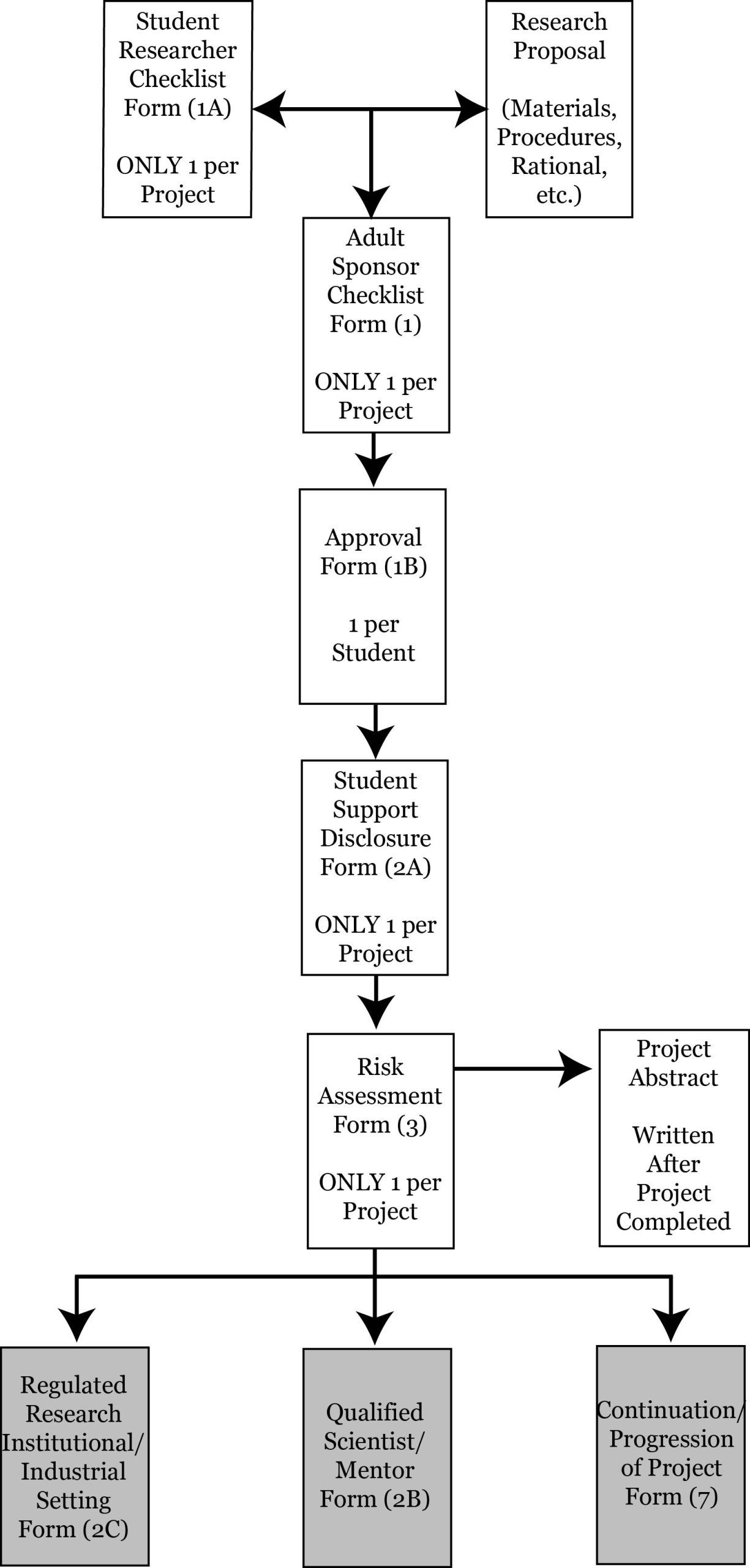
Form 1 – Checklist for Adult Sponsor
This form should be done once the Student Checklist (1A) and Research Plan are near completion. Please note that the Adult Sponsor should sign and date this form according to the date of REVIEW and APPROVAL and not the date of signature. This is useful if the students have research notebooks and the teacher reviews and initials those before transferring everything to the forms.
Form 1A – Student Checklist
This form should be completed in conjunction with the Research Plan. On this form, students should outline details about when and where the experimentation will take place.
**NOTE** If a student wishes to continue collecting data between competitions (i.e., after the Regional Science Fair and before CSEF), then a research amendment form should be completed indicating a new anticipated end date – HOWEVER, no new procedures may be added.
Research Plan
This should be typed and completed in conjunction with the Student Checklist Form (1A). It must be a detailed account of what the student(s) anticipate doing in the experimental portion of the project.
Any project dealing with Human Subjects, Vertebrate Animals and/or Potentially Hazardous Biological Agents (i.e. microorganisms, bacteria, etc.) MUST be reviewed by an Institutional Review Board and/or Scientific Review Committee prior to any experimentation beginning.
Form 1B – Approval Form
This form should be completed once the Student Checklist, Research Plan, Checklist for Adult Sponsor, Risk Assessment and any other needed forms for the type of project are all completed. Sections 1 & 2a (if applicable) must be signed prior to experimentation. Sections 3 & 2b (if applicable) will be signed just prior to a student competing in a regional science fair.
Form 2A – Student Support Disclosure Form
This is a NEW form for 2027 and is required for all projects. It can be completed either prior to or after experimentation but MUST include ALL adult support given to the student(s).
Form 3 – Risk Assessment Form
The CSEF requires all students using the Middle School forms to complete a Risk Assessment Form 3 that outlines the potential risks and hazards that might be associated with the project as well as assign an adult who will DIRECTLY supervise the student while they are working on their project. Please note that a student can have more than one Designated Supervisor, but they must complete separate Form 3s to outline what they are helping with. ALL sections MUST be completed with details about how the student is going to be safe while working on the project.
This form should be completed in conjunction with the Research Plan and is a review of the risks that MIGHT be associated with the project (see the CSEF rules & guidelines for more information on potential risks and hazards a student might encounter in their research) and must be completed PRIOR to experimentation.
**NOTE** There are certain chemicals that are banned for use in Colorado schools.
**NOTE** Students should reference the Materials Data Sheets for ALL chemicals used – these can give important information that is needed to complete the Form 3.
**NOTE** The Designated Supervisor MUST explain how they are qualified to supervise the use of whatever hazards are listed in the Riska Assessment – being Mom or Dad is not a qualification.
Form 2B – Qualified Scientist
This form is completed PRIOR to experimentation and is used to document when a Student Researcher works with a mentor who is a professional in the area of their project. A Qualified Scientist should have the following qualifications:
- Earned a doctorate/professional degree in a scientific field related to the student’s area of research AND/OR
- Has extensive experience and expertise in the student’s area of research.
- Be thoroughly familiar with the regulations that govern the student’s area of research including all local, state and federal regulations and laws.
- Can also serve as the Adult Sponsor, if they meet both sets of qualifications.
- May live elsewhere and not be local to the student, in which case, a Designated Supervisor must be appointed and trained to serve as the onsite supervision as necessary.
Form 2C – Regulated Research Institutional/Industrial Setting
This form is completed AFTER experimentation is done and is a summary of what the Student Researcher did at a professional lab or industrial setting. This is to be completed by the supervising adult who is affiliated with the laboratory and who has first-hand knowledge of the student’s work.
Form 7 – Continuation/Research Progression Projects Form
Any project that is based on the student’s prior research could be considered a continuation/research progression project. This form documents that the additional research is a significant expansion from prior work and is completed AFTER experimentation.
Repetition of previous experimentation with the same procedures and research question, even with an increased sample size, is an example of an unacceptable continuation.
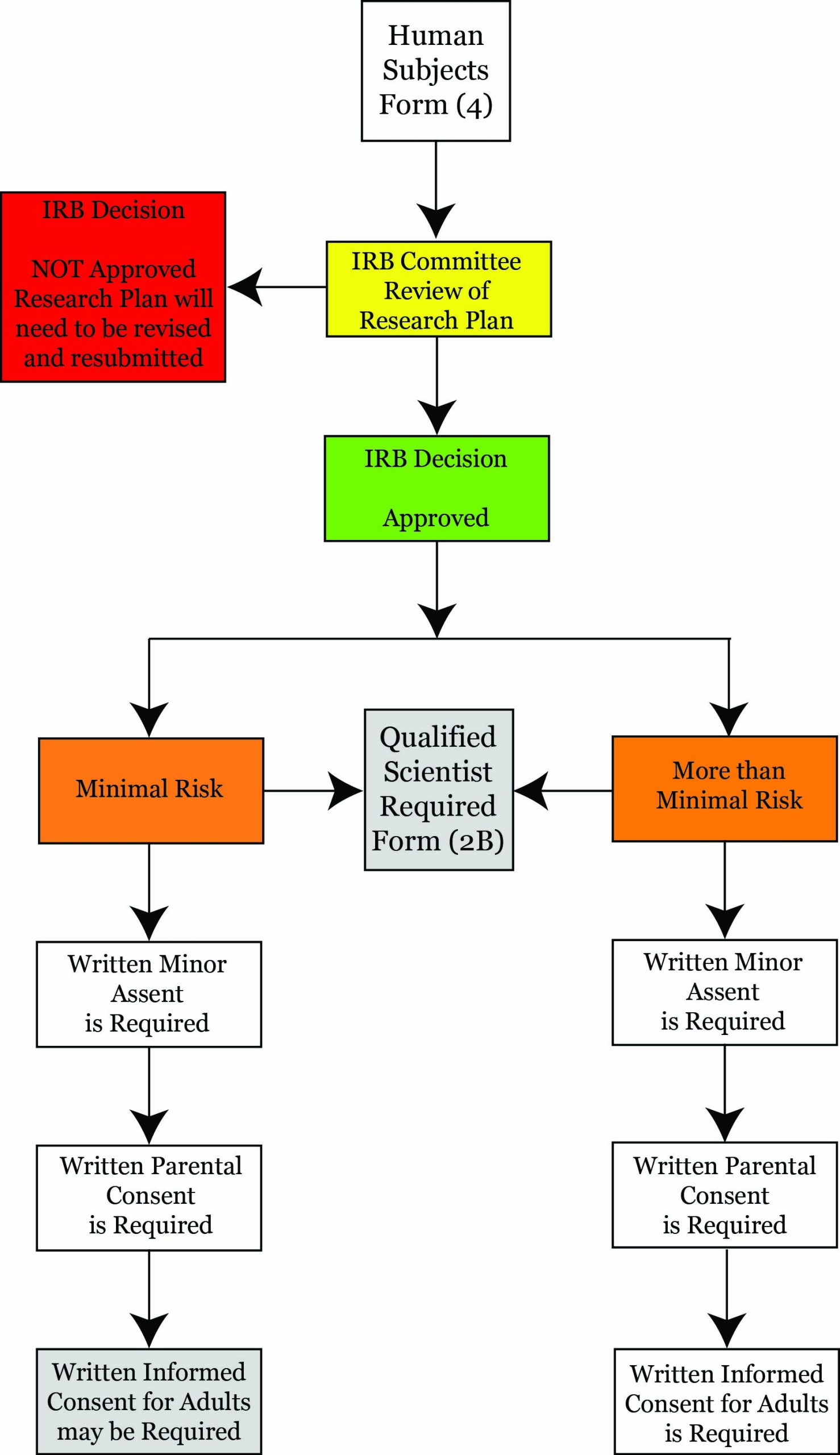
Form 4 – Human Participants
This form is used to document Institutional Review Board (IRB) approval of the student’s proposed research using human test subjects (see the CSEF rules & guidelines for more information on human subject research projects) and must be completed PRIOR to experimentation.
The Research Plan for a project using Human Subjects must include all of the following (much of this information can be transcribed directly onto the Informed Consent Form):
- Subjects: Describe who will participate in the study (age range, gender, racial/ethnic composition). Identify any vulnerable populations (minors, pregnant women, prisoners, mentally disabled or economically disadvantaged) that might be a target population.
- Recruitment: Where will you find your subjects? How will they be invited to participate?
- Methods: What will participants be asked to do (be specific!)? Will you use any surveys, questionnaires or tests? What is the frequency and length of the time involved for each subject?
- Risks: What are the risks or potential discomforts (physical, psychological, time involved, social, legal, etc.) to the participants? How will you minimize those potential risks?
- Benefits: List any benefits to society or individual participants.
- Protection of Privacy: Will any identifiable information (i.e., names, phone numbers, birth dates, email addresses, ages, etc.) be collected? Will data be confidential or anonymous (confidential means that the information collected will only be accessible to the Student Researcher and Adult Sponsor; anonymous means that there is absolutely no way that anyone can link a person’s participation in the project to the data gathered)? How will confidentiality or anonymity be maintained?
- Informed Consent Process: Describe how you will inform participants about the purpose of the study, what they will be asked to do, that their participation is voluntary, and they have the right to stop at any time.
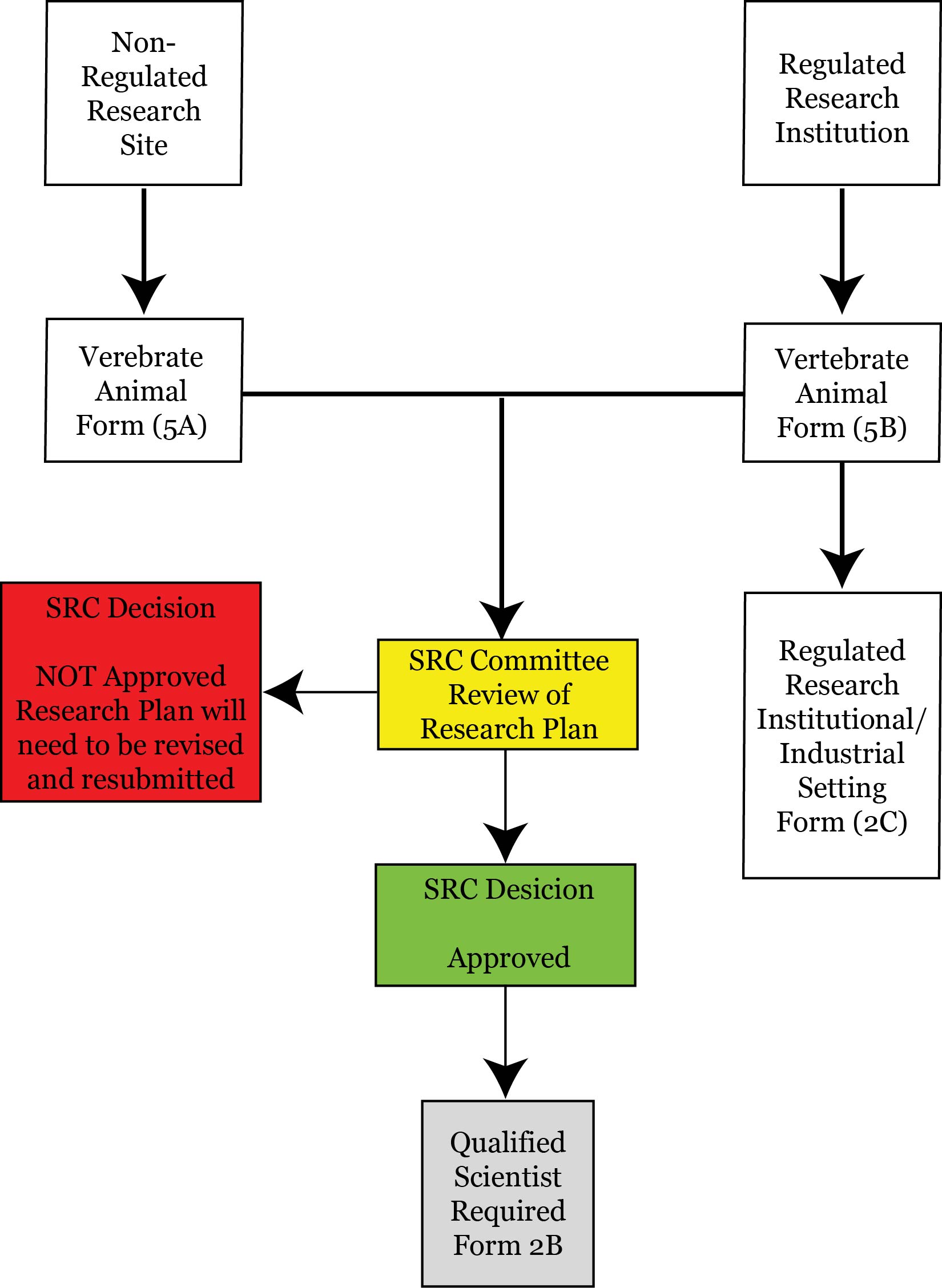
Form 5A/5B – Vertebrate Animal
These forms are used to document the Scientific Review Committee (SRC) approval of a student’s proposed research using vertebrate animals (see the CSEF rules & guidelines for more information on vertebrate animal research). Form 5A is used when the study is conducted at a home, school or field setting. Form 5B is used when the study is conducted at a regulated research institution and must be accompanied by that institution’s IACUC documentation.
The Research Plan for a project using Vertebrate Animals must include all of the following (much of this information can be transcribed directly onto Form 5A/5B):
- A discussion of potential alternatives to the use of vertebrate animals and detailed justification as to why vertebrate animals must be used.
- An explanation of the potential impact or contribution this research may have.
- Detailed procedures to be used, including methods used to minimize potential discomfort, distress, pain and/or injury to the animals during the course of experimentation and detailed chemical concentrations and drug dosages if applicable.
- Detailed number of animals being used, the species, strain, sex, age, etc. including justification for the number of animals planned for the research.
- Description of the housing and oversight of daily care.
- Discussion about the disposition of the animals at the termination of the study.
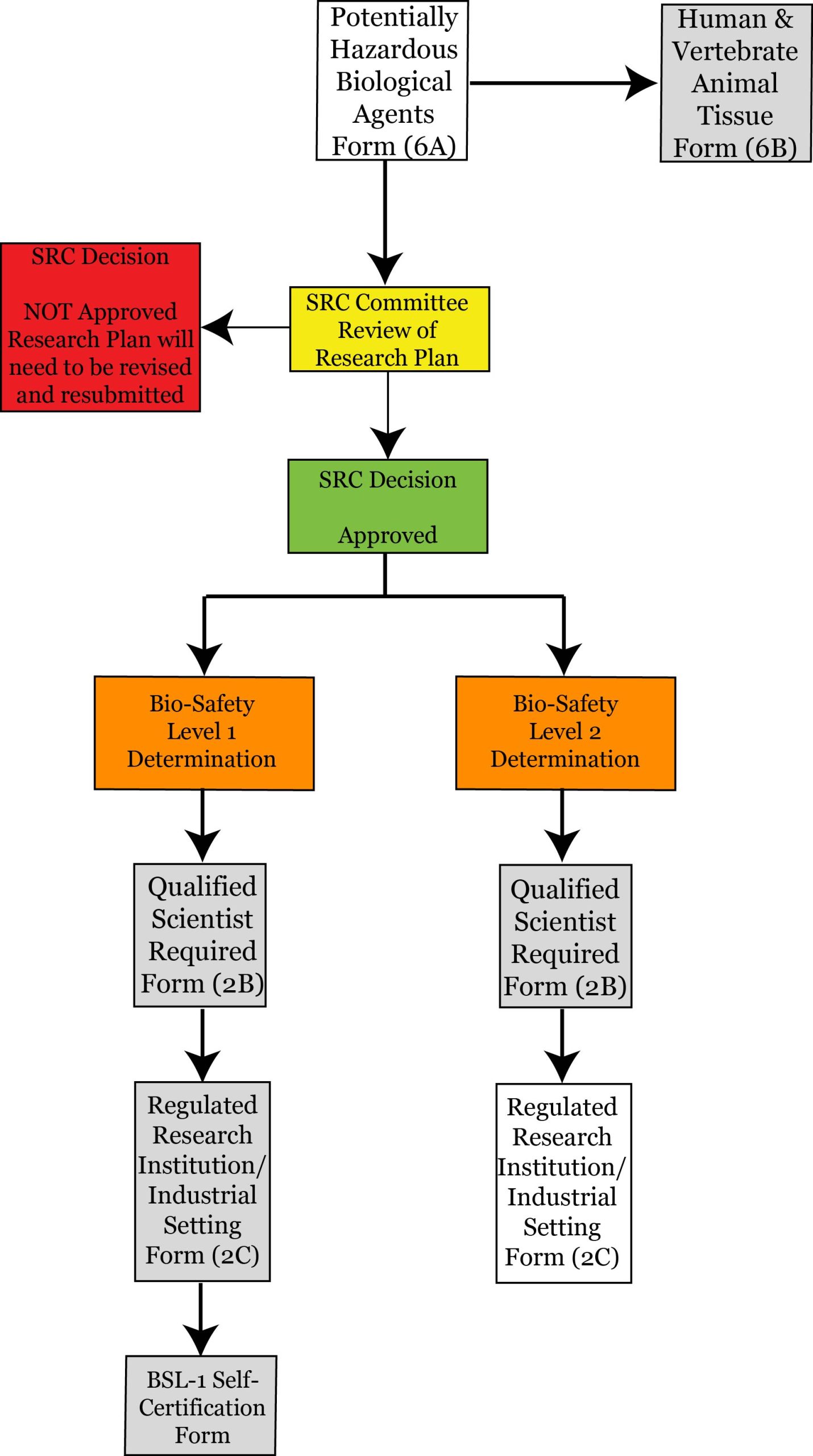
Form 6A – Potentially Hazardous Biological Agents Risk Assessment
This form is used to document the potential risks associated with any hazardous biological agents (including unknown bacteria collected from the environment) as well as the Scientific Review approval of the proposed research plan (see the CSEF rules & guidelines for more information on hazardous biological agent research).
Students must work with their Adult Sponsor or Designated Supervisor to assign a BioSafety Level to the research being proposed. These are the definitions for each BSL:
- BSL-1 risk group contains biological agents that pose a low risk to personnel and the environment. These agents are highly unlikely to cause disease in healthy lab workers, animals or plants. These agents require a BioSafety Level 1 containment. Examples of BSL-1 organisms include Agrobacterium tumefaciens, Micrococcus leuteus, Neurospora crassa, Bacillus subtilis.
- BSL-2 risk group contains biological agents that pose moderate risk to personnel and the environment. If exposure occurs in a lab situation, the risk of spread is limited, and it would rarely cause infection that would lead to serious disease. These agents require a BioSafety Level 2 containment. Examples of BSL-2 organisms include Mycobacterium, Streptococcus pneumoniae, Salmonella choloerasuis.
- BSL-3 risk group contains biological agents that usually cause serious disease or that can result in serios economic consequences. Projects in the BSL-3 group are prohibited.
- BSL-4 risk group contains biological agents that usually produce very serious disease that are often untreatable. Projects in the BSL-4 group are prohibited,
Form 6B – Human & Vertebrate Animal Tissue
This form is used to document the type and source of tissue(s) being used in the student’s project. All tissue studies must complete BOTH Form 6A and 6B prior to experimentation (see the CSEF rules & guidelines for more information on tissue research).
